
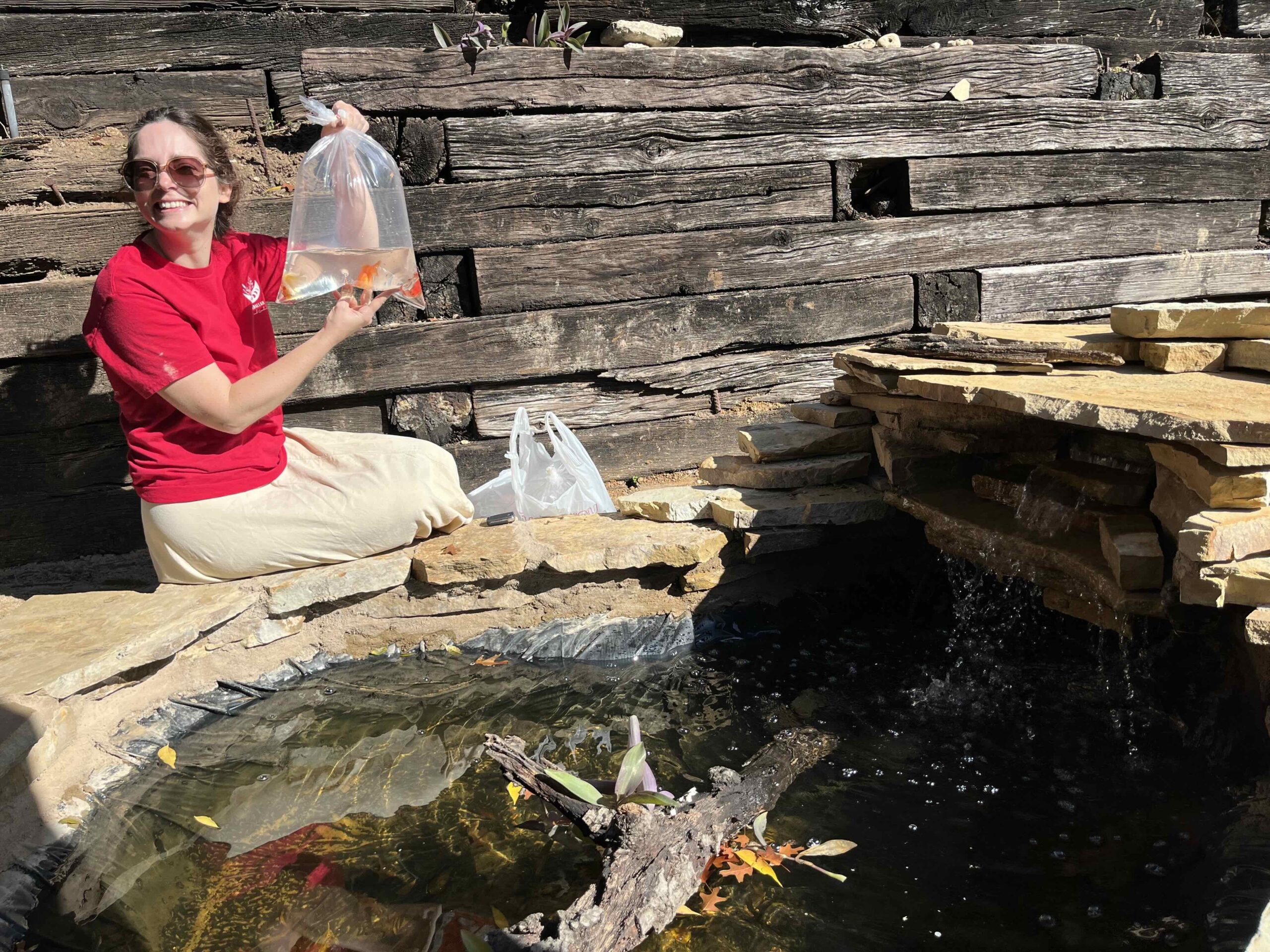
Meet Dr. E. Jane Bradbury, the founder of Shamballah Home and Gardens. Dr. Jane is an entrepreneur, mother, botanist, educator, and hermetic scientist.
She received her doctorate from the University of Wisconsin-Madison Botany Department, specializing in ethnobotanical relationships between humans and landscapes.
Dr. Jane became dissatisfied with Western science as the only avenue for exploring the mysteries of life and began studying metaphysics and the Hermetic sciences, which, in turn, gave her a deeper understanding of the natural world around us.
After years in academia and scientific research, she was inspired to bring balance; she co-founded Shamballah Home and Gardens to offer Austin-area clients a more conscious, connected approach to landscape design in Austin. Learn more about her journey and inspiration.
What first inspired you to start Shamballah Home and Gardens?
Honestly, I was inspired to start Shamballah Home and Gardens after moving back to Austin, having completed my doctorate and post-doctorate positions, and every day seeing unattractive and ecologically harmful landscape design choices. I have always loved gardening and had designed a number of gardens for friends and colleagues while living in Wisconsin. One day, while driving past a huge new mixed-use development that was going in along a super sensitive riparian zone by my neighborhood, I was so frustrated with their landscaping choices that I exclaimed, “I could do this better!” And in that moment, I realized, wait—I actually could, which always makes me laugh a little to this day. I also knew that, for people to make better choices for their land, they needed a better option available, and so I resolved to give them that option: stewardship over ownership.
How did your academic background inform your approach to design?
Certainly, my academic background is a cornerstone of my design work. While getting my PhD in Botany, I specialized in the relationships between people, plants, cultures, and landscapes, as understood through ecosystem management and cultivation systems. I worked closely with many different paradigms, both Western and Indigenous, to understand both the biological and cultural aspects to land management. This gives me a unique perspective on how human interactions with the land impact the broader ecosystem. Many people don’t realize it, but landscape design choices are some of the most direct, environmentally impactful choices we make, along with our food choices.
When did you realize you wanted to integrate spiritual/metaphysical perspectives with ecology and design?
Really, it was never separate. My spiritual connection with nature was the foundation of my desire to pursue a degree in Botany. Indeed, one of the biggest differences between cultures that prioritize a healthy and nurturing relationship with the Earth instead of an exploitative and extractive relationship with the Earth is a deep connection to Universal Spirit. For me, science was a way to understand the miracle and mystery of Spirit—I never saw the two as separate, but merely the visible vs invisible aspects of the same world. Even when I taught Introductory Biology for 5 years at the University of Texas at Austin, the first entire third of the course material was about energy. Everything manifest is first vibration.
What’s a misconception people often have about combining “science” and “spirituality” in design, and how do you address it?
Most people, truthfully, do not think beyond the world they can sense with their physical senses. However, probably the greatest misconception is that science and spirituality are mutually exclusive concepts, when they are not. Science is a method of observing reality, and it is not the only method for doing so. Spirituality helps us understand who we are, what we are, where we come from, where we are going, and what our purpose in life is. Eliminating either one results in suffering. In the context of landscaping, designs that only operate in the scientific are uninspiring, lack beauty, and lose artistry, but designs that lack scientific grounding fail to thrive. Both are needed, and they complement one another.
How would you describe your design philosophy or your “guiding principles”?
My primary mission in life is to support humanity in shifting its relationship with the planet from one of extractive ownership to one of divine stewardship. Every design is an expression of the unique relationship between the people involved and the land. Just as every person expresses their unique individuality differently, every property has its own specific combination of needs. I see my designs as reconciling and bringing into harmony the individual expression (as desires) of the stewards and the needs of the land being stewarded. Therefore, each design is its own unique living piece of art.
What role do sustainability, stewardship, and biodiversity play in your work?
These are central values to the mission of Shamballah Home and Gardens. Just as I consider each design as a microcosm, I also consider how each design functions in the larger urban ecosystem.
How do you balance aesthetics with ecological function?
What is interesting is that if we study the sort of “guiding principles of beauty” across any form of art, we discover certain core trends again and again. These principles actually align really well with maximizing ecological function. Health is something that is almost always correlated with beauty. Words like “vibrant” and “lush” are examples that show the intersection of health and beauty. Diversity is a similar cornerstone. We much prefer aesthetics with complexity over monotony. What a “coincidence” that these are also core aspects to ecological success!
In your mind, how does landscape design in Austin intersect with personal/spiritual transformation?
In addition to my formal career and education in science, I have also studied Hermetics, or the foundational metaphysical principles, since 2019. One of the core Hermetic Laws, which most people at this point have heard, is the Law of Correspondence, which partially states, “As Within, So Without. As Without, So Within.” It is, in fact, impossible to change your outer environment, especially your personal vessel (home), without also experiencing internal change. Anyone who has had children, or even adopted their first pet, has experienced this principle in action. No one can experience these external changes without also experiencing internal shifts.
Our space is critically important for our internal world. Many scientific studies show how cluttered, messy spaces negatively affect our mental health, for example. And correspondingly, we have likely all experienced how when we are in a low-vibrational state—exhaustion, depression, grief, for example—our spaces suffer and our external environment begins to reflect our internal state. Conversely, we know spaces of extreme beauty, such as royal palaces and cathedrals, are aspirational and inspire awe and elevate mood. Both science and spirituality agree that changing your space can absolutely change your life.
What does “raising vibration” or “cultivating unity” look like in a garden or outdoor space?
At the end of the day (and the beginning!), everything is vibration. Certain frequencies have higher or lower vibration, and we can all feel this. Anger, fear, and chaos are examples of lower vibration frequencies. Beauty, harmony, unity, love, and joy are all examples of higher vibration frequencies. These frequencies can be generated bi-directionally — you can start internally, in the non-physical, or you can start externally, in the physical. By utilizing color, sacred geometries, and ecological principles, we create spaces that resonate with the frequencies of life, joy, beauty, harmony (a foundational prerequisite for unity), and love. When the plants are happy, everyone is happy!
What are your favorite “go-to” plants for landscape design in Austin?
On the one hand, every design is unique, because the microclimates of each property, the sun and water availability, temperature shielding or exposure, soil conditions, etc., are all slightly different, so I always pick plants that will thrive where they are planted, and this means that I don’t necessarily have plants I use all the time. In fact, one of the comments about my designs that I get most from other contractors (and especially my suppliers) in the business is that I am using plants they have never seen or heard of before. However, sometimes, especially when working with the City of Austin WaterWise Rebate program, I am constrained by certain requirements. The City of Austin has a fabulous “Grow Green” guide that contains dozens of excellent plants suited to the local ecosystem, many of which I use regularly. And, one plant I almost always work into my designs (unless deer predation is a concern) is our beloved mascot plant, Wax Mallow (Malvaviscus arboreus), which encompasses so many of the values of the brand–it is native, has beautiful foliage and red spiral flowers (nice sacred geometry!), supports bees, butterflies, and hummingbirds, and grows under a huge range of conditions, so I can always count on it for success!
What’s your vision for you, and by extension, Shamballah Home & Gardens?
My vision is of a world where humans improve the ecosystem instead of harming it. So many people believe that human existence is inherently harmful to the natural world, and I cannot stress how false this belief is–both biologically and spiritually. Indeed, this belief is just as colonial as the destructive exploitation of the natural world that generated it. However, we know from an abundance of scientific research that when humans engage in stewardship of natural spaces, biodiversity increases, resilience to disturbance and stress increases, total ecological productivity (abundance) increases, ecological harmony and stability increases — life increases. We have seen this most reliably in traditional indigenous ecological management systems, so we know that it is possible for humans to be a beneficial force in the world. Bringing that understanding into the modern era — not by rejecting civilization but by reshaping civilization, not by ignoring technology but by integrating technology — that is my vision. Eden was a garden, and so Shamballah will be, too.
What trends (ecological, aesthetic, cultural) are you watching or predicting for the next 5–10 years?
Certainly, our current resource use and allocation are unsustainable. I expect to see an increasing realization and subsequent emphasis on needing to live in harmony with our planet instead of in ownership of it. We can either choose to change before we are forced to change, or we can be forced to change. But the change is inevitable.
If you could design a “dream garden” (no restrictions), what would it be like?
Huge!! And multi-faceted. Areas for walking, areas for reflection, areas for sensory engagement (scents, textures, tastes — so often I feel like gardens are a “look and don’t touch” scenario, and I would love to design an interactive garden), teaching gardens, wild-crafting areas, managed wild spaces, children’s gardens, examples of different ecosystems, galactic gardens, fairy gardens, geometric gardens — all the gardens!
If you’re ready to transform your property into a piece of living art, our landscape design Austin team is here to help! Reach out to us today to get started!