
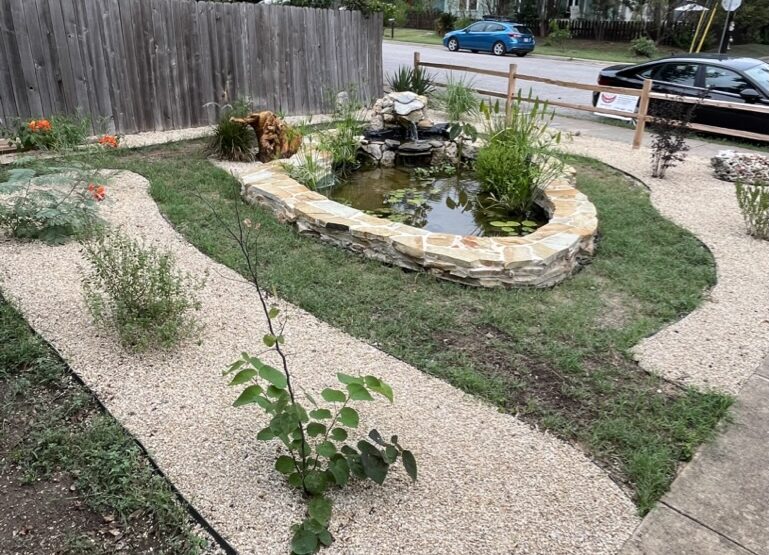
As stewards of the land, we make it our mission to prioritize water-wise or water-conscious landscaping. The World Resources Institute has released studies indicating that water is expected to become a critically limited resource globally within the next 30 years, and over 30 countries are expected to be under high water stress by 2040.
By helping to reduce water use in our landscape designs, we can not only support our local water table but also help reduce stress on the planet.
What is Water Conscious Landscaping or Water Wise Landscaping?
Water-conscious landscaping is landscape design focused on minimizing overall water use and using water strategically for the highest impact and efficiency, during installation and ongoing maintenance.
Water Conscious Landscaping will:
- Avoid sprinklers
- Use native plants and plants adapted to your area.
- Rebuild the soil to absorb and retain more water.
- Match plants to the property’s microclimates.
- Prioritize water use to increase ecosystem resilience and support keystone species and wildlife.
This approach is not only better for the planet and our water table, but it also cuts down on your monthly water bills!
Water Conscious vs. Water Wise vs. Xeriscaping
All of these terms refer to reducing water use, but they have distinct meanings. Water-conscious is the broadest term, and water wise and xeriscaping are considered examples of ways to be water-conscious.
“WaterWise” specifically refers to the City of Austin rebate program guidelines that use that same name, which support water-conscious landscaping projects that meet certain requirements set forth by the city. By partnering with the City of Austin, we help homeowners transform their lawns into vibrant, water-conscious spaces. Our team handles the paperwork and compliance for you. We submit your application, ensure your design meets rebate requirements, and guide you through the process. Customers can receive up to $3,000 in rebates for qualifying projects, and we make the process seamless from start to finish.
“Xeriscaping” is a type of landscape design that aims to use no supplemental water. It often includes rock installations and heavy use of succulents. Succulents are plants that store water in their leaves. Although xeriscaping uses the least water, it often requires many non-native plants that do not support local pollinators. Also, large gravel areas can increase evaporation and retain less rainfall, making them less “ecologically beneficial.”
Why Water Conscious Landscaping Matters (Especially in Austin)
Central Texas is already familiar with the effects of climate change on water availability, having experienced multiple record-breaking droughts since 2010. Biologically, water is life, on every level–no living organism can live without water. That is why water conservation is a central priority of stewardship.
Our Approach to Water Conscious Landscaping
Our default design mode is water-conscious. There needs to be a compelling purpose for a more water-intensive design; even then, we will work to conserve water. For example, if we are using a tropical plant, we target drip irrigation, or if we are installing a stretch of lawn, we use water-conserving ornamental border plants to allow deep water saturation in the margins and have water wick to the center of the lawn.
We focus on microclimates and on where water naturally runs and gathers on the property. This will determine where a higher-needs plant needs to go, and we will place lower-water plants in the drier areas of the property.
Sunlight drives a plant’s water needs, and avoiding putting a high-water-use plant in a full-sun spot would reduce its water use. Water-conscious landscaping involves matching plants to their places.
Benefits:
Reducing water use in our landscape designs offers more than just water savings. In fact, these are a few benefits that illustrate why water-wise practices make sense for both your home and the environment:
- Lower water bill
- Increased resilience during drought
- Stronger support for local ecosystems
- Higher percentage of native plants benefiting pollinators and wildlife
Tips + Dos & Don’ts
When picking out plants for a water-conscious garden, choose varieties that thrive with minimal supplemental watering. For example, the entire genus of Salvia (the sages) is highly water-conscious, comes in a wide variety of shapes, colors, and textures, and pollinators love them!
Our mascot plant, wax mallow, requires almost no additional water supplementation beyond the natural rainfall and provides gorgeous color and leaf texture to any landscape design.
If you want to incorporate more water-conscious practices, these are some essential dos and don’ts:
- Do use native plants.
- Do increase organic matter in soil.
- Do pick a nice native ground cover and mulch to reduce evaporation.
- Don’t install sprinkler irrigation.
- Don’t install big stretches of lawn.
- Don’t overutilize tropical ornamental varieties.
If you are ready to create water wise landscaping and start your stewardship journey, reach out today!