
Water Retention in Landscape Design
Water is the heartbeat of every living landscape and is the biggest factor in whether a landscape thrives or struggles, especially in Central Texas. At Shamballah Home & Gardens, water retention isn’t an add-on feature we tack onto a design; it’s the foundation everything else is built on. Here’s how we think about water, from the moment we walk a property to the plants we choose to put in the ground.
Understanding a Property Before We Design
Every design begins with an understanding of how water moves and settles across a site. Microclimating—assessing light availability, directionality, soil quality, and gradients—is one of the first things we do during an initial property survey. Soil quality indicates how much water a site will absorb and retain when it rains, while gradients indicate where water will naturally run and collect. We also factor in where the property sits within the city itself: rainfall in Austin can vary by 1 to 3 inches across a single storm, depending on location. These variables guide us in placing plants with intention and help to calibrate irrigation so that every drop of water is conserved. From our very first visit, we create a landscape as unique as your land that also maximizes water conservation and efficiency.
Sponge Gardens, Sponge Paths, and Sponge Berms | Water Retention in Landscape Design
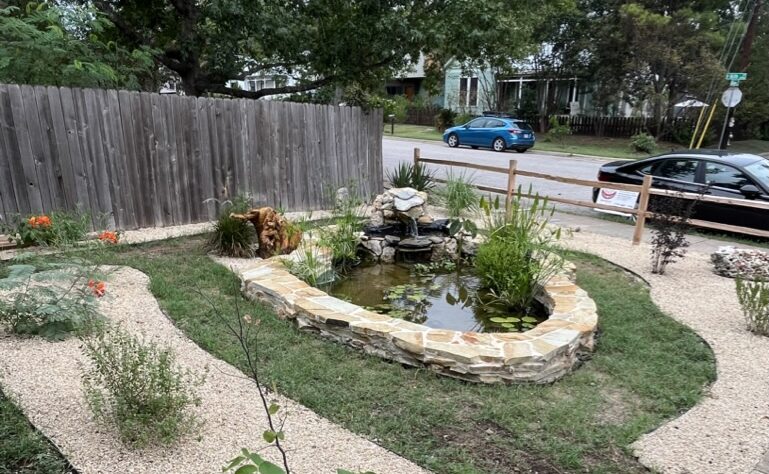
Once we see how water moves across your land, we can choose where to slow it down and help it soak in. For holding water, sponge features work well. Whether it is a sponge path, berm, or garden, the idea is the same. We dig a trench and fill it with layers of different materials, creating an underground reservoir. What we plant on top depends on the feature: gravel for a path, native grasses or meadow plants for a berm, and garden plants for a sponge garden. When it rains, water fills the reservoir and is slowly released back into the soil, nourishing the beds or lawn instead of running off.
Hardscaping can play a role here too, though it takes some intention. Technically, anything covered in gravel can be “sponged,” and that means skipping landscaping fabric. Impermeable surfaces like stone or pavers can also be subtly graded so water channels into a nearby catchment, like a sponge berm or path. Standard hardscaping, on its own, isn’t great for water conservation because it reduces absorption and increases evaporation, which is exactly why it isn’t covered by the City of Austin’s WaterWise rebate program.
Soil Health Is the Real Foundation
None of this works without healthy soil underneath it. Soil health is one of the most important factors in water retention. It’s the driving force behind our soil rehabilitation program, built into the long-term maintenance plan for every property we work on — and it’s why our designs require less water over time. As we rebuild soil health, the ground absorbs and retains more of every rain that falls, season after season.
Plants That Work With Water And Not Against It
Choosing the right plants for your land helps manage water and supports the local ecosystem. For water retention, we use a mix of plants with different root types. Some have shallow, fibrous roots that help water soak in at the surface. Others have deep roots that reach through the tough clay layer found in many Austin soils. We also look for plants that can take in heavy rain quickly and then go for long stretches of drought. Plants from the mallow family, like desert globe mallow, wax mallow, Althea, and rock rose (Pavonia), are some of our favorites for these conditions.
Native and drought-tolerant plants do more than save water. We make sure there is always something blooming until the weather is too cold for insects to stay active. A summer landscape without flowers leaves nothing for wildlife that cannot escape the heat. In nature, some animals depend on one plant or a small group of plants, like monarch butterflies and milkweed. Others, like most bees, can use many different plants. Both types rely on timing, so we choose species that grow, bloom, and rest in step with the local seasons.
Water Retention in Landscape Design That Works at Any Scale
One of the strengths of this approach is that it works for properties of any size. Water retention features can be created for small city lots or large acreages, and they don’t require separate permits because they don’t increase impermeable ground cover.
Built Into the Shamballah Method From Day One
Water retention is foundational to the Shamballah Home & Gardens method, not an upgrade. Every design is created and installed so that water retention on a property improves over time, even without a standalone feature like a sponge garden. That said, we always encourage clients who are already planning pathways or other eligible hardscaping to consider the added value of building a sponge feature alongside it. Strategically placed, sponge features can even eliminate the need to water lawns outside of the harshest months of the year. Like everything we do, it’s an investment that pays for itself over time.
If you’re just starting to think about any of this for your own property, talk to us sooner rather than later. Our initial consultation is free, and we’ve seen so many homeowners come to us late in the process, after they’ve already lost time and money trying to figure things out on their own. You don’t need a fully formed plan before reaching out. Starting the conversation early is the best way to save yourself time, money, and headaches down the road.
Ready to create a landscape that supports water retention in your landscape design and your local ecosystem? Contact us for a free consultation.